According to a comprehensive analysis by Market Research Future, the global Green Building Market was valued at USD 610.6 billion in 2024 and is projected to grow from USD 669.8 billion in 2025 to USD 1,690.6 billion by 2035, at an impressive compound annual growth rate (CAGR) of 9.70% throughout the forecast period. This near-tripling of market value over a decade — at a growth rate that substantially outpaces overall construction sector expansion — reflects the extraordinary structural momentum behind sustainable construction as a global imperative, an economic proposition, and a regulatory requirement simultaneously converging to make green building the defining construction market opportunity of the decade ahead.
What Is Green Building and Why Is Its Moment Now?
Green building is not a single technology or product but rather an integrated design philosophy and construction practice that simultaneously addresses a building’s energy performance, water efficiency, material sourcing, indoor environmental quality, site ecology, and operational carbon footprint across its complete lifecycle from design through construction, occupancy, renovation, and eventual end-of-life. The green building approach is fundamentally about systems thinking — recognizing that a building’s total environmental impact is determined not by any single choice but by the integrated performance of its envelope, mechanical systems, lighting, controls, orientation, shading, landscaping, and occupant behavior working together as a coherent whole. This systems integration is precisely what certification frameworks like LEED and BREEAM have codified into measurable scoring systems that allow the environmental performance of buildings to be objectively assessed, compared, and verified by independent third parties — creating the market signal transparency that enables green buildings to command rental premiums, lower vacancy rates, higher asset values, and preferential access to green finance instruments that justify the upfront investment in sustainable design and construction.
The moment for green buildings has arrived with decisive finality for several converging reasons. Regulatory frameworks across major markets are progressively mandating minimum building energy performance standards that converge with green building specifications — the EU’s Energy Performance of Buildings Directive (EPBD) and its zero-emissions building requirements, the US Department of Energy’s increasingly ambitious model energy codes, China’s mandatory green building standards for public buildings, and India’s Energy Conservation Building Code (ECBC) are collectively pulling the regulatory floor of new construction toward what was green building’s voluntary frontier just a decade ago. Simultaneously, the economic case for green buildings has strengthened as energy prices have risen, construction technology has matured, and the 15-year operational energy saving period over which green buildings recoup their premium construction costs has become a shorter break-even horizon as energy efficiency technologies have declined in cost. Perhaps most powerfully, the financial sector’s adoption of ESG (Environmental, Social, and Governance) investment frameworks has created a structural premium for green-certified building assets — green buildings access green bonds, sustainability-linked loans, and carbon-conscious institutional investment capital at costs and on terms unavailable to conventional buildings — making green certification a financial asset as much as an environmental credential.
Get An Exclusive Sample of the Research Report: https://www.marketresearchfuture.com/sample_request/4982
Key Market Drivers Propelling Growth to 2035
The Environmental Awakening and Consumer Consciousness: The most foundational driver of the green building market’s extraordinary growth trajectory is the profound shift in environmental consciousness among consumers, businesses, governments, and financial institutions worldwide. Research consistently shows that approximately 70% of consumers are willing to pay premiums for eco-friendly products and services — a preference that extends to the homes they choose to inhabit and the office buildings where they work. This consumer orientation is being translated into building design through the wellness movement, which recognizes that green buildings — with their superior indoor air quality from low-VOC materials and enhanced ventilation systems, their access to natural daylight through optimized glazing, their thermal comfort through high-performance envelopes, and their connection to nature through biophilic design elements — deliver measurably better health and productivity outcomes for occupants. The World Green Building Council’s data indicating that green buildings can enhance workplace productivity by up to 15% transforms the sustainability investment from a corporate responsibility cost into a human capital performance dividend that sophisticated occupiers and building owners have begun to price into their real estate decisions.
Government Incentives, Policies, and Regulatory Escalation: Government policy is the most powerful single driver of green building market acceleration, operating through both regulatory mandates that make sustainable performance progressively unavoidable and financial incentives that make it economically attractive. The US Department of Energy’s Building Technologies Office programs, tax credits for energy-efficient commercial buildings under IRA provisions, and state-level green building incentives have catalyzed a substantial increase in LEED-certified building stock across North American markets. The EU Green Deal and its associated EPBD revision — which requires all new buildings to be zero-emission by 2030 and sets demanding renovation trajectories for existing buildings — is effectively mandating green building performance across the world’s most regulated building market. China’s mandatory green building standards for government-funded projects and its ambitious targets for green building percentage of new construction starts are transforming the world’s largest construction market. India’s ECBC and the Bureau of Energy Efficiency’s green building programs are beginning to shift a market of extraordinary scale toward higher performance standards. The cumulative effect of this global regulatory escalation is to progressively narrow the competitive advantage of conventional construction over green construction, making the green premium shrink even as the green market expands.
Rising Energy Efficiency Standards as Economic Imperative: The International Energy Agency’s finding that energy-efficient buildings can reduce energy consumption by up to 50% compared to conventional equivalents translates directly into operational cost savings that have become increasingly compelling as energy prices have risen and volatility has increased following the disruptions of the early 2020s. For commercial building owners and operators, energy cost is typically the second-largest operating expense after labor, and the 20–50% energy savings achievable through green building design represent a permanent structural improvement in operating economics that immediately enhances net operating income and, through capitalization, asset value. As energy prices rise and carbon pricing mechanisms expand across more jurisdictions, the relative economics of green buildings versus conventional buildings improve with each passing year, pulling forward investment in sustainable construction that might otherwise have been deferred. The break-even analysis that previously required 15 years of energy savings to recover green premium construction costs now achieves positive net present value within 7–10 years in many markets, with payback periods continuing to compress as building technology improves and fossil energy costs escalate.
Health, Wellness, and Indoor Environmental Quality: The COVID-19 pandemic dramatically accelerated awareness of the relationship between indoor environmental quality and human health, creating a new and powerful demand driver for green building features that improve ventilation rates, filtration efficiency, natural air circulation, surface hygiene, and access to natural light and outdoor views. Post-pandemic return-to-office dynamics have been decisively shaped by employee preferences for healthy, well-ventilated, daylit workspaces — preferences that track closely with the indoor environmental quality features that green-certified office buildings are designed to provide. Real estate research consistently shows that LEED-certified and WELL-certified buildings achieve lower vacancy rates and higher rental premiums than comparable conventional buildings in tight commercial real estate markets — translating the health and wellness credentials of green buildings into directly measurable financial performance metrics that building investors, developers, and landlords can model and capitalize.
Buy this Premium Research Report: https://www.marketresearchfuture.com/checkout?currency=one_user-USD&report_id=4982
Technological Innovation: From Passive Design to Smart Buildings: The convergence of green building with smart building technology is creating a new generation of highly sophisticated sustainable structures where passive design excellence — high-performance envelopes, optimized orientation and shading, natural ventilation design — is augmented by intelligent active building systems that continuously optimize energy use, occupant comfort, and system performance in real time. Building automation systems (BAS) with AI-driven algorithms can reduce HVAC energy consumption by 20–30% beyond the savings achievable with conventional controls by predicting occupancy patterns, anticipating weather conditions, optimizing equipment staging, and identifying emerging maintenance issues before they become energy-wasting faults. Johnson Controls’ August partnership announcement with a technology firm to develop advanced AI-driven building management systems, Siemens’ September initiative targeting sustainable retrofitting of existing buildings, and Schneider Electric’s July Asian manufacturing facility expansion for green building technologies all illustrate the pace at which the world’s leading building technology companies are investing in the smart-green building convergence. BlocPower’s USD 155 million fundraising in March 2023 — securing equity and debt capital to retrofit hundreds of thousands of homes and structures with energy-efficient technologies — exemplifies the scale of private capital being mobilized for the building decarbonization opportunity.
Market Segmentation Insights
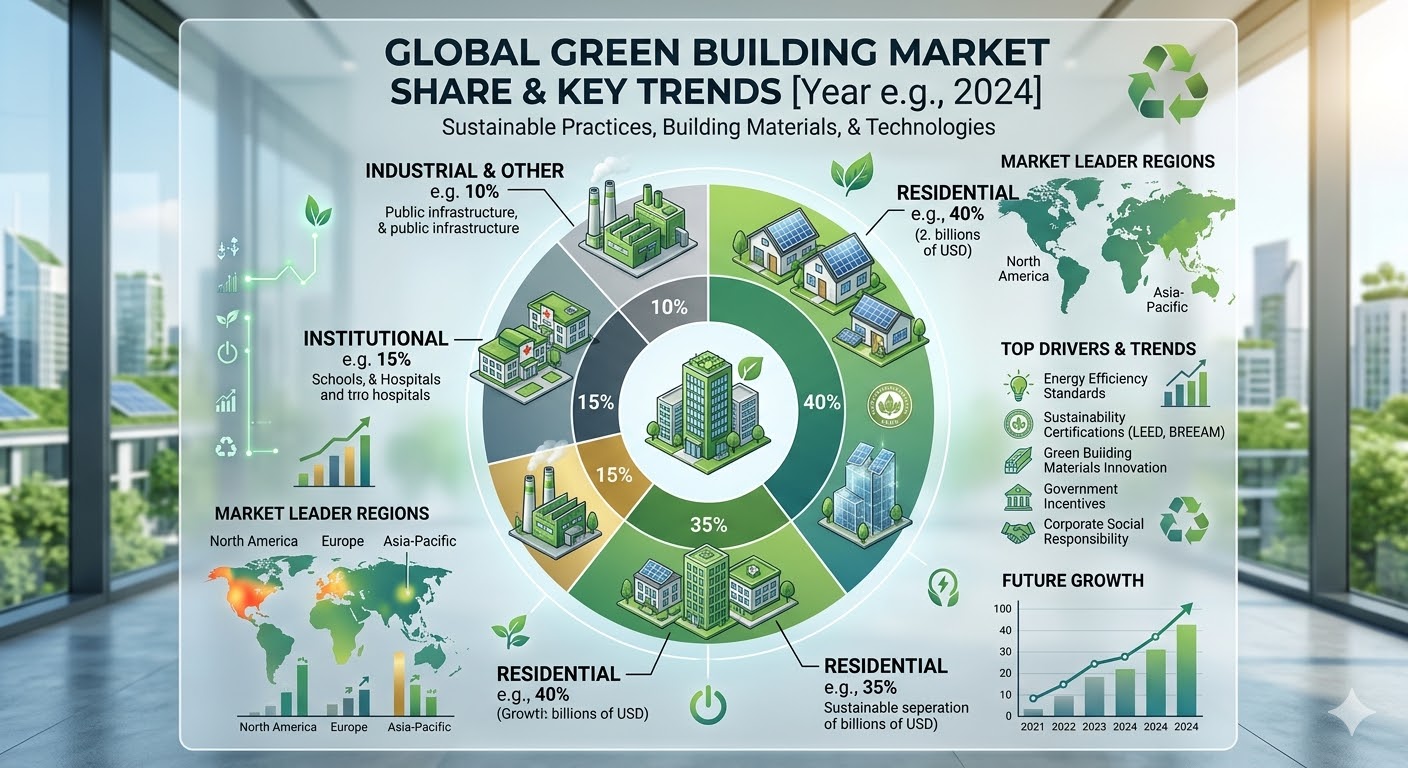
By Product — Interiors Lead, Exteriors Grow Fastest: Green building interiors — encompassing sustainable flooring, low-VOC paints and coatings, energy-efficient lighting systems, advanced HVAC with heat recovery, smart controls, sustainable furniture and finishes, and water-efficient fixtures — hold the dominant product share at approximately USD 304.45 billion in 2024. The interior environment’s direct impact on occupant health, productivity, and energy consumption makes it the primary focus of green building specification and the area where the density of sustainable product innovation is highest. Green building exteriors — encompassing high-performance building envelopes (walls, roofs, and glazing with superior insulation and thermal mass), green roofs and living walls, solar facades and integrated photovoltaics, rainwater management systems, and sustainable landscaping — are the fastest-growing product category, valued at approximately USD 456.67 billion in 2024 and growing rapidly as building energy codes push toward zero-energy performance levels that make the building envelope’s thermal resistance the decisive design variable. The proliferation of building-integrated photovoltaics (BIPV) — where solar cells are incorporated into roofing materials, facade cladding, and glazing systems as structural and aesthetic building elements rather than bolted-on afterthoughts — is creating an exciting new category of exterior green building product with strong growth momentum.
By Application — Residential Leads, Non-residential Grows Fastest: The residential application holds the largest market share at approximately USD 304.45 billion in 2024, reflecting the sheer scale of global residential construction activity and the deep consumer demand for sustainable, energy-efficient, and healthy homes that is visible across every income level and geography. Government affordable housing programs in emerging markets that mandate minimum green building standards, developed market renovation incentive programs that accelerate energy-efficiency retrofitting of existing homes, and consumer willingness to pay premiums for new homes with certified sustainability credentials all contribute to the residential sector’s dominant market position. The non-residential application — encompassing commercial office buildings, retail, hospitality, healthcare, education, and industrial facilities — is the fastest-growing segment, valued at approximately USD 456.67 billion in 2024 and expanding at above-average rates as corporate ESG commitments drive green building specification, as commercial real estate investors recognize the green premium in rental rates and asset values, and as institutional building owners in healthcare and education face growing public accountability for their environmental footprint.
Regional Market Dynamics
North America holds the world’s largest regional share at approximately 40% of the global green building market, driven by the US’s mature LEED certification ecosystem (with over 100,000 LEED-certified buildings globally, many in the US), robust government incentive programs, stringent state and municipal building codes in California, New York, Massachusetts, and other progressive jurisdictions, and a sophisticated commercial real estate investment community that has embedded green building credentials into standard asset management practice. Johnson Controls, Honeywell, and Trane Technologies anchor the North American competitive landscape with comprehensive building technology portfolios spanning HVAC, controls, fire safety, and integrated energy management systems.
Europe accounts for approximately 30% of the global market and is the world’s most regulation-driven green building market, where the EU’s EPBD revision and national building energy performance regulations are systematically narrowing the gap between conventional and green construction performance requirements. Germany, the UK, France, and the Nordic countries lead European green building adoption, with Siemens and Schneider Electric as the dominant European building technology companies. The EU Green Deal’s goal of climate neutrality by 2050 — supported by the EPBD’s requirement for zero-emission new buildings and ambitious renovation targets for existing stock — creates an essentially permanent regulatory demand signal for the European green building market that will sustain above-average growth through the forecast period and well beyond.
Asia-Pacific holds approximately 20% of global market share and is firmly established as the fastest-growing region, with China and India as the primary demand engines. China’s mandatory green building requirements for government-funded projects, its ambitious national targets for green building share of new construction, and its enormous new construction volume are collectively making China’s green building market one of the world’s largest in absolute terms. India’s growing ECBC compliance requirements, its expanding IGBC (Indian Green Building Council) and GRIHA certification ecosystems, and the integration of green building requirements into smart city programs are accelerating sustainable construction adoption across a market that adds approximately 1 billion square meters of new floor area every year. Schneider Electric’s July establishment of a new Asian manufacturing facility for green building technologies directly reflects the strategic priority of positioning for Asia-Pacific’s green building growth leadership.
Middle East and Africa holds approximately 10% of global market share but is growing at rates that reflect both the urgency of the region’s sustainability challenge — extreme climate, high energy intensity, and rapidly growing building stock — and the ambition of its governmental sustainability programs. The UAE’s Vision 2021 and subsequent sustainability frameworks, Saudi Arabia’s Vision 2030 green building commitments, and South Africa’s expanding green building certification infrastructure are transforming a region historically associated with energy-intensive construction into a dynamic green building innovation frontier.
Competitive Landscape and Key Developments
The global green building market is served by a highly diverse competitive ecosystem encompassing materials manufacturers (BASF, Saint-Gobain, Owens Corning, DuPont, Holcim, Sika, PPG Industries), building technology and systems companies (Johnson Controls, Siemens, Schneider Electric, Honeywell, Trane Technologies), specialty green building product companies (Kingspan Group, Interface, Rockwool International), and sustainability consulting and engineering services firms (Buro Happold, Accenture’s sustainability practice). Each layer of this ecosystem is experiencing rapid growth and strategic investment.
Accenture’s June 2023 acquisition of Brazilian sustainability consultancy Green Domus — specifically focused on measurable decarbonization strategies — reflects the management consulting sector’s recognition that building decarbonization advisory is a high-growth professional services category. BlocPower’s USD 155 million fundraising for residential building retrofit at scale demonstrates the venture capital community’s conviction that the building retrofitting market represents one of the largest climate tech investment opportunities available. Binderholz’s acquisition of BSW Timber — creating Europe’s largest sawmill and solid wood processor — positions it as the leading supplier of mass timber and engineered wood products that are increasingly specified in green building construction as lower-embodied-carbon alternatives to concrete and steel. Lafarge Egypt’s 2021 launch of Ecolabel cement in Egypt illustrates how green building material innovation is spreading beyond mature markets into emerging market construction supply chains.
For more insights on Market, visit the Market Research Future page and explore detailed market analysis, forecasts, and company strategies.
Duplex Stainless Steel Pipe Market
Rubber Tyre Gantry Crane Market
Autoclaved Aerated Concrete Market
Translucent Concrete Market
Green Concrete Market
Metal cladding Market
Recycled Construction Aggregates Market