Mordor Intelligence has published a new report on the emission monitoring systems market, offering a comprehensive analysis of trends, growth drivers, and future projections
Emission Monitoring Systems Market Outlook
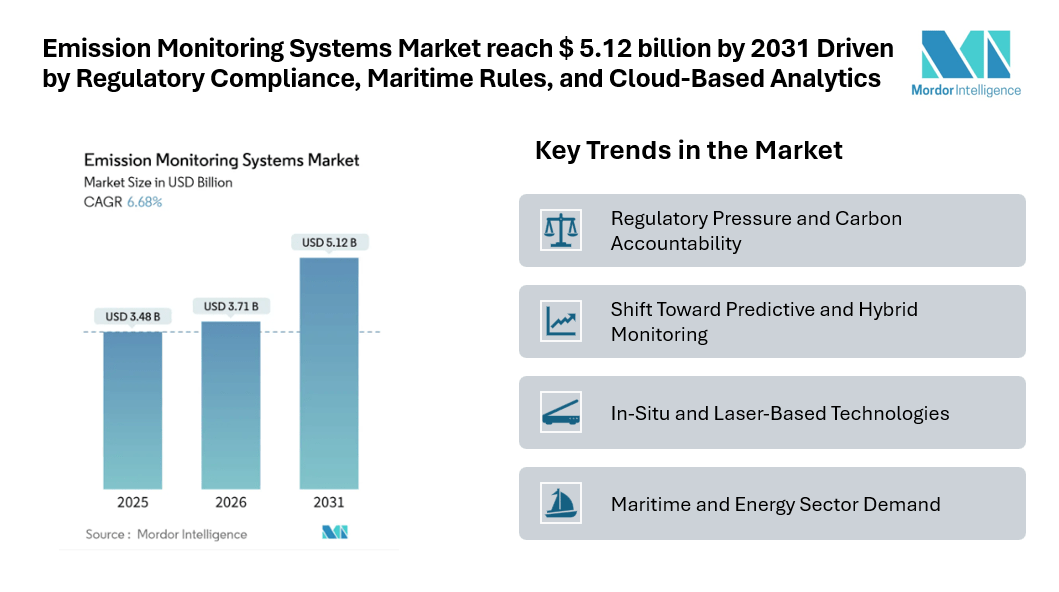
The emission monitoring systems market size is projected to be USD 3.48 billion in 2025, USD 3.71 billion in 2026, and reach USD 5.12 billion by 2031, growing at a CAGR of 6.68% from 2026 to 2031. The emission monitoring systems industry is witnessing steady expansion as governments, regulators, and corporations tighten environmental reporting requirements and carbon accountability frameworks across power generation, manufacturing, oil and gas, maritime shipping, and waste management sectors.
Regionally, Asia Pacific leads the emission monitoring systems market share due to large-scale retrofits under national clean-air programs and rapid industrial expansion. Meanwhile, the Middle East is emerging as the fastest-growing region as refinery upgrades and modernization projects move forward. The emission monitoring systems market forecast also reflects rising investments in hybrid monitoring architectures, predictive analytics, and cloud-based diagnostics that help reduce operating costs while maintaining compliance accuracy.
Growth Drivers Shaping the Emission Monitoring Systems Market
Regulatory Pressure and Carbon Accountability
Strict environmental regulations remain the primary driver of emission monitoring systems market growth. Governments increasingly require continuous reporting of pollutants such as sulfur oxides, nitrogen oxides, carbon dioxide, and particulate matter. Compliance frameworks now include penalties, trading schemes, and verification processes that depend on reliable measurement systems. Carbon markets amplify this trend. Organizations operating in emission trading environments must submit accurate data to calculate allowances and obligations. Even small measurement discrepancies can translate into significant financial consequences, making high-precision monitoring essential.
Shift Toward Predictive and Hybrid Monitoring
Another notable development in the emission monitoring systems market trends is the shift from purely hardware-based systems to hybrid solutions that combine sensors with predictive software models. Predictive emission monitoring systems use operational data to estimate emissions continuously, reducing reliance on costly physical measurements while maintaining regulatory compliance. Hybrid architectures that integrate continuous measurement with predictive analytics are gaining traction because they lower maintenance costs, improve uptime, and provide redundancy. Cloud-hosted analytics platforms also enable centralized oversight across multiple facilities, which is particularly valuable for multinational operators.
In-Situ and Laser-Based Technologies
Technological improvements within the emission monitoring systems industry include growing adoption of in-situ measurement techniques and laser-based sensors. These solutions measure emissions directly within exhaust streams, eliminating the need for sample extraction and reducing delays caused by conditioning processes. In-situ systems are especially useful in high-temperature or high-humidity environments where traditional extractive methods may struggle. Industries such as power generation, cement production, and waste incineration are increasingly deploying these technologies to improve reliability and reduce operational complexity.
Maritime and Energy Sector Demand
Shipping regulations targeting vessel emissions are expanding the scope of the emission monitoring systems market beyond land-based facilities. Ship-board monitoring is becoming mandatory for compliance with fuel standards and emission limits, creating a new demand segment within the market. Simultaneously, modernization projects in refineries, gas processing plants, and power stations continue to generate strong demand. Utilities in particular rely on accurate stack monitoring to manage both environmental obligations and operational efficiency.
Check out more details and stay updated with the latest industry trends, including the Japanese version for localized insights: https://www.mordorintelligence.com/ja/industry-reports/emission-monitoring-systems-market?utm_source=emailwire
Emission Monitoring Systems Market Segmentation
By System Type
- Continuous Emission Monitoring Systems (CEMS)
- Predictive Emission Monitoring Systems (PEMS)
By Component
- Hardware
- Software
- Services
By Monitoring Technology
- Extractive
- Dilution
- In-Situ
By End-User Industry
- Power Generation
- Oil and Gas
- Metals and Mining
- Chemicals and Petrochemicals
- Pharmaceuticals
- Cement and Aggregates
- Pulp and Paper
- Waste-to-Energy and Incineration
- Maritime
By Geography
- North America
- South America
- Europe
- Asia Pacific
- Middle East
- Africa
Explore Our Full Library of Technology, Media and Telecom Research: https://www.mordorintelligence.com/market-analysis/technology-media-and-telecom?utm_source=emailwire
Key Players in the Emission Monitoring Systems Industry
- ABB Ltd.
- Siemens AG
- Emerson Electric Co.
- General Electric Company
- AMETEK Inc.
Explore more insights on emission monitoring systems competitive landscape: https://www.mordorintelligence.com/industry-reports/emission-monitoring-systems-market/companies?utm_source=emailwire
Conclusion
The future of the emission monitoring systems industry is closely linked to environmental governance, carbon management, and industrial modernization. As climate policies become stricter worldwide, organizations will continue investing in reliable monitoring infrastructure to demonstrate compliance and manage environmental risk. Digital transformation within heavy industries is further reinforcing the importance of real-time data visibility. Cloud analytics, remote diagnostics, and predictive models are expected to become standard components of monitoring solutions, helping operators optimize performance while reducing operational costs.
Regional dynamics will also shape the emission monitoring systems market forecast. Asia Pacific is likely to maintain leadership due to industrial activity and pollution-control initiatives, while the Middle East’s refinery upgrades and infrastructure projects will sustain rapid growth. Maritime regulations will expand opportunities across global shipping routes, adding a cross-border dimension to market demand. Overall, the emission monitoring systems market growth trajectory reflects a structural shift toward transparency and accountability in industrial emissions. Organizations increasingly recognize that accurate environmental data is not just a regulatory requirement but a strategic asset influencing financial outcomes, operational efficiency, and corporate reputation. As a result, the emission monitoring systems industry is set to remain a critical component of the global transition toward cleaner and more accountable industrial operations.
Industry Related Reports:
Ultraviolet Disinfection Equipment Market
The ultraviolet (UV) disinfection equipment market is experiencing robust growth, driven by increasing demand for chemical-free water and air purification solutions across municipal, healthcare, and industrial sectors. Rising concerns over waterborne diseases, stricter environmental regulations, and post-pandemic emphasis on sanitation are accelerating adoption worldwide, supporting a strong double-digit growth trajectory.
The electronic nose market is expanding steadily due to growing applications in food quality monitoring, environmental sensing, healthcare diagnostics, and industrial safety. Advances in sensor technologies, AI integration, and the need for rapid, non-invasive detection of gases and odors are key factors fueling market growth over the forecast period.
The gas detectors market is witnessing moderate but consistent growth, supported by stringent workplace safety regulations and rising demand from oil & gas, mining, manufacturing, and chemical industries. Increasing awareness of occupational hazards, coupled with technological improvements in portable and fixed detection systems, continues to drive market adoption globally.
Explore our latest LinkedIn update for more market insights:
Facial Recognition Market, https://www.linkedin.com/pulse/facial-recognition-market-outlook-industry-structure-nriwf/
Programmable Logic Controller (PLC) Market, https://www.linkedin.com/pulse/plc-market-outlook-size-trajectory-industry-structure-itxoc/
Smartphones Market, https://www.linkedin.com/pulse/smartphones-market-outlook-size-structure-industry-5whqc/
E-book Market, https://www.linkedin.com/pulse/ebook-market-outlook-size-structure-industry-qllzc/
About Mordor Intelligence:
Mordor Intelligence is a trusted partner for businesses seeking comprehensive and actionable market intelligence. Our global reach, expert team, and tailored solutions empower organizations and individuals to make informed decisions, navigate complex markets, and achieve their strategic goals.
With a team of over 550 domain experts and on-ground specialists spanning 150+ countries, Mordor Intelligence possesses a unique understanding of the global business landscape. This expertise translates into comprehensive syndicated and custom research reports covering a wide spectrum of industries, including aerospace & defense, agriculture, animal nutrition and wellness, automation, automotive, chemicals & materials, consumer goods & services, electronics, energy & power, financial services, food & beverages, healthcare, hospitality & tourism, information & communications technology, investment opportunities, and logistics.
For any inquiries or to access the full report, please contact:
media@mordorintelligence.com
https://www.mordorintelligence.com/
Mordor Intelligence, 11th Floor, Rajapushpa Summit, Nanakramguda Rd, Financial District, Gachibowli, Hyderabad, Telangana – 500032, India.